

Apa’s Return
One of mountaineering’s most celebrated legends is creating upward mobility for his community
Story and photography by Spenser Heaps for Deseret Magazine.
Lhakpa Tenzing Sherpa was wrapped tightly in a blanket, carried by his mother, Yila Futi Sherpa, in a bamboo basket. It was spring 1956.
The snows high above the village of Thame — located in Nepal’s Solukhumbu region near Mount Everest — were beginning to melt. While tending to the family’s yaks in the high alpine meadows above her home, Yila heard a loud crash. It sounded like the mountain above her was heaving into collapse. She knew what this sound meant. With Lhakpa on her back, she dashed for cover beneath a rocky crag, just before an avalanche roared down — a torrent of snow plowing away nearly everything in its path and burying the rest.
As the avalanche subsided, Yila went to comfort baby Lhakpa, taking her basket off her back. But her son wasn’t there. In a frantic search of despair, she clawed through the snow, desperately hoping to save her son. Then, suddenly, his scream pierced the silence. Lhakpa was alive.
For the Sherpa people who inhabit the mountainous regions of Nepal and Tibet, almost all children are named for the day of the week on which they were born. Lhakpa means “Wednesday.” But, the high lama of the nearby monastery and his parents chose a new name for this child to celebrate the miracle of his survival. He was renamed Apa, meaning “love.”
~~~
Fifty-five years later, Apa looked down at the world from the summit of Chomolungma — meaning “Goddess Mother of the World” in his native language. It was his 21st time on the summit of the peak also called Mount Everest. He had set a new world record.
In fact, he had broken his own record 11 times. His strength in the mountains had earned him a new nickname: Super Sherpa.
During his career as a guide on the highest mountain in the world, Apa Sherpa had risen to fame in his country and the worldwide adventure community. His mountaineering income had provided a good living in Nepal, but moving the family to Draper, Utah, allowed Apa and his wife Yangin’s children access to better education and opportunities. But it felt bittersweet. He loved climbing Everest, the first few times. But, “that many times? No.” Turns out, the career of one of the world’s most decorated mountaineers was a career he never wanted.
“Climbing was not my goal,” Apa says. “I wanted to get an education and become a doctor ... I wanted to save the people’s lives.”
But in the Khumbu and Solukhumbu regions of Nepal, pursuing an education is a choice not all are free to make. In fact, after his father passed away when he was only 12, Apa had to begin working full time as a mountain porter to support his family.
He says he wants the people who grow up in the shadow of Mount Everest to have the chance to climb the mountain if they want to, but not be compelled to because it’s the only way to feed their families. “If they have the education, then they have a choice,” Apa explains. His dream is that with better access to education, the next generation of Nepali children won’t have to risk their lives in the mountains to provide for their families.
~~~
The year following his retirement in 2011, Apa and his business partner, Jerry Mika, opened the Apa Sherpa Foundation. In order to provide educational opportunities in Khumbu and Solukhumbu, the foundation pays teacher salaries, runs a hot lunch program to keep kids nourished and supplies hard goods like computers and furniture for local schools. The foundation is small now, but Apa hopes it can grow large enough to expand aid to all of Nepal, not just the region he grew up in.
For the past 11 years, Apa has flown annually from Utah to Khumbu to see firsthand what the kids need and how the foundation can help. He brings a cadre of trekkers with them to help deliver the aid, and with the hope that they will become ambassadors for the foundation.
But because of the pandemic, it’s been three years since Apa was last here. To limit the spread of COVID-19, Nepal shut its doors to the tourists that flock annually to the Everest region. Now, with restrictions lifted, tourists and climbers have started to return, but Apa says the trails and teahouses are still too quiet. It’s a reminder of the importance of his goal of creating a more diverse economy.
~~~
In Thame, Apa receives a hero’s welcome. Ironically, school is canceled for his arrival, but the students still come, as do all of their parents. Along with school officials. And townspeople. And Sherpa cultural groups. It’s a celebration. Buddhist mantras are recited and offerings are made. Kids perform dances and present Apa with khata scarves. After, teacher Om Prasad Bhattarai gives a lengthy speech in which he calls Apa the village’s “guardian."
In Nepal, government support for education is piecemeal. Only six of the nine teachers in Thame are funded by the government. The donations from the foundation are critical in creating salaries that other teachers can depend on.
Apa wears a wide grin as the reception unfolds. Although he’s reached plenty of summits, helping kids get a better education is the pinnacle of his work.
“I’m very proud, the kids are doing good,” he says with a soft smile. Apa Sherpa may not have been a doctor like he dreamed as a child, but here and now in his hometown, he’s found a different way to save lives.
To learn more about the Apa Sherpa Foundation and their mission to improve education in Nepal, visit their website.

Namche Bazaar, the largest village in Nepal's Khumbu region.

Apa Sherpa and his group of trekkers cross a suspension bridge over the Imja Khola river, with Ama Dablam visible in the background.

Apa hikes past prayer wheels on his way back to his hometown, Thame.

Apa Sherpa, and his granddaughter Tashi, 7, are welcomed at the Thame Basic School. This was Tashi's first time ever visiting Nepal.
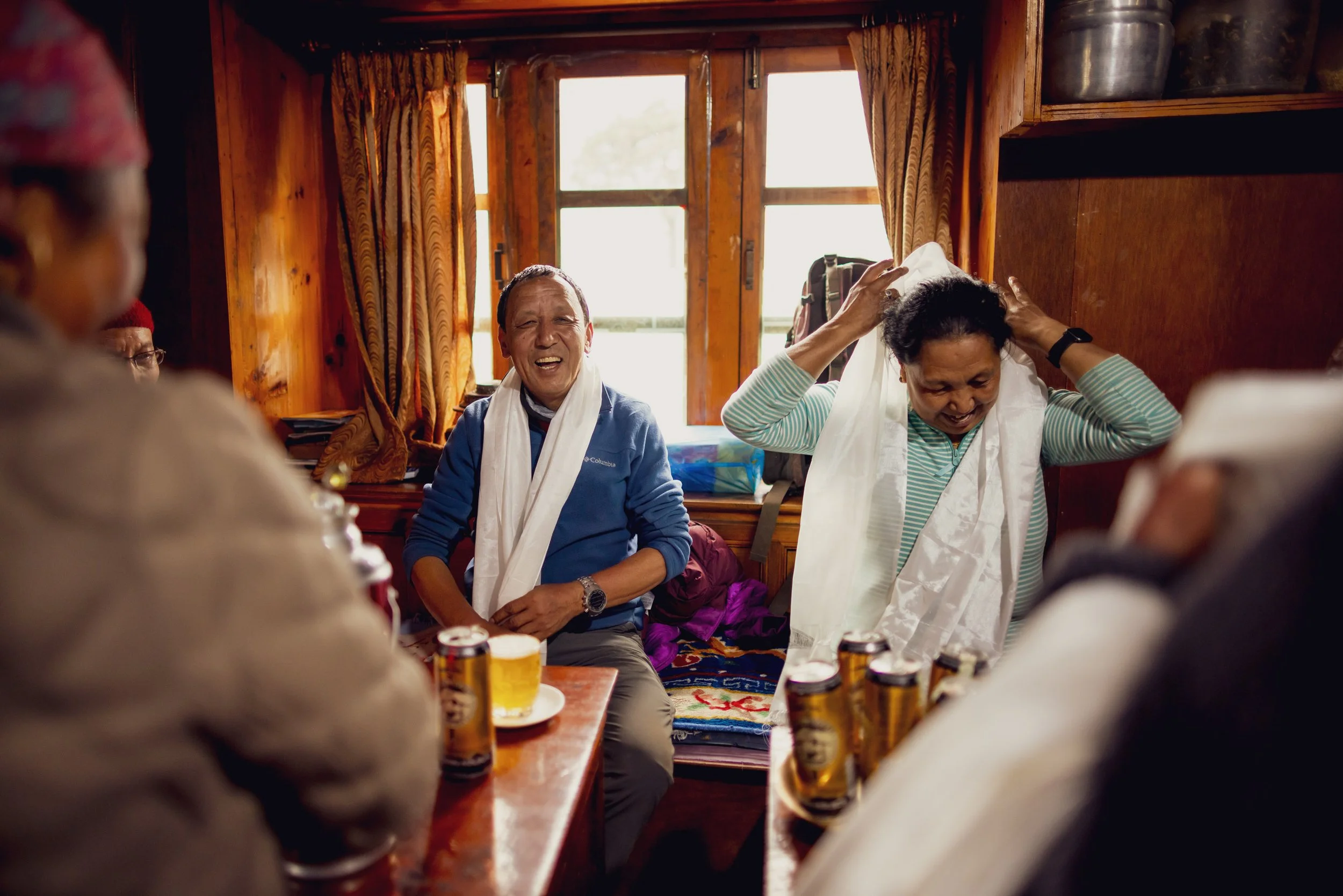
Apa Sherpa and his wife, Yangjin, receive visitors bearing milk tea and beer at their home in Thame.

Yangjin Sherpa greets Apa Sherpa's wife, also named Yangjin, right, in Thamo.

Thame, Apa Sherpa’s home town, is pictured at sunrise.

A buddhist chorten stands above Thame.

Teachers, students and parents gather at the Thame Basic School to welcome Apa Sherpa, representatives of his foundation and a group of trekkers at the school. The school was built by Sir Edmund Hillary in 1963.


Fura Gyalzen Sherpa, 5, and classmates work on a lesson at the Thame Basic School.
Bipin Rei, 7, gobbles up his lunch at the Shree Pema Chholing Ghyang Basic School in Ghat. The Apa Sherpa Foundation funds a hot lunch program at the school.

Teacher Anil Thapa works with students at Thame Basic School.

A member of the Thame Women's Group holds a bowl of rice wine used in a ceremony welcoming Apa Sherpa back to the Thame Basic School.

Apa Sherpa delivers brand new computers to teachers at the Thame Basic School.

Yanjee Sherpa, left, works in the kitchen at the Shree Pema Chholing Ghyang Basic School in Ghat.


Nurbu Sherpa, a school board member at the Shree Pema Chholing Ghyang Basic School in Ghat, Nepal, poses for a portrait at the school, where the Apa Sherpa Foundation funds a hot lunch program.
Students at the Shree Pema Chholing Ghyang Basic School in Ghat watch a welcoming presentation for Apa.

Young monks sit together at the Thame Monastery.
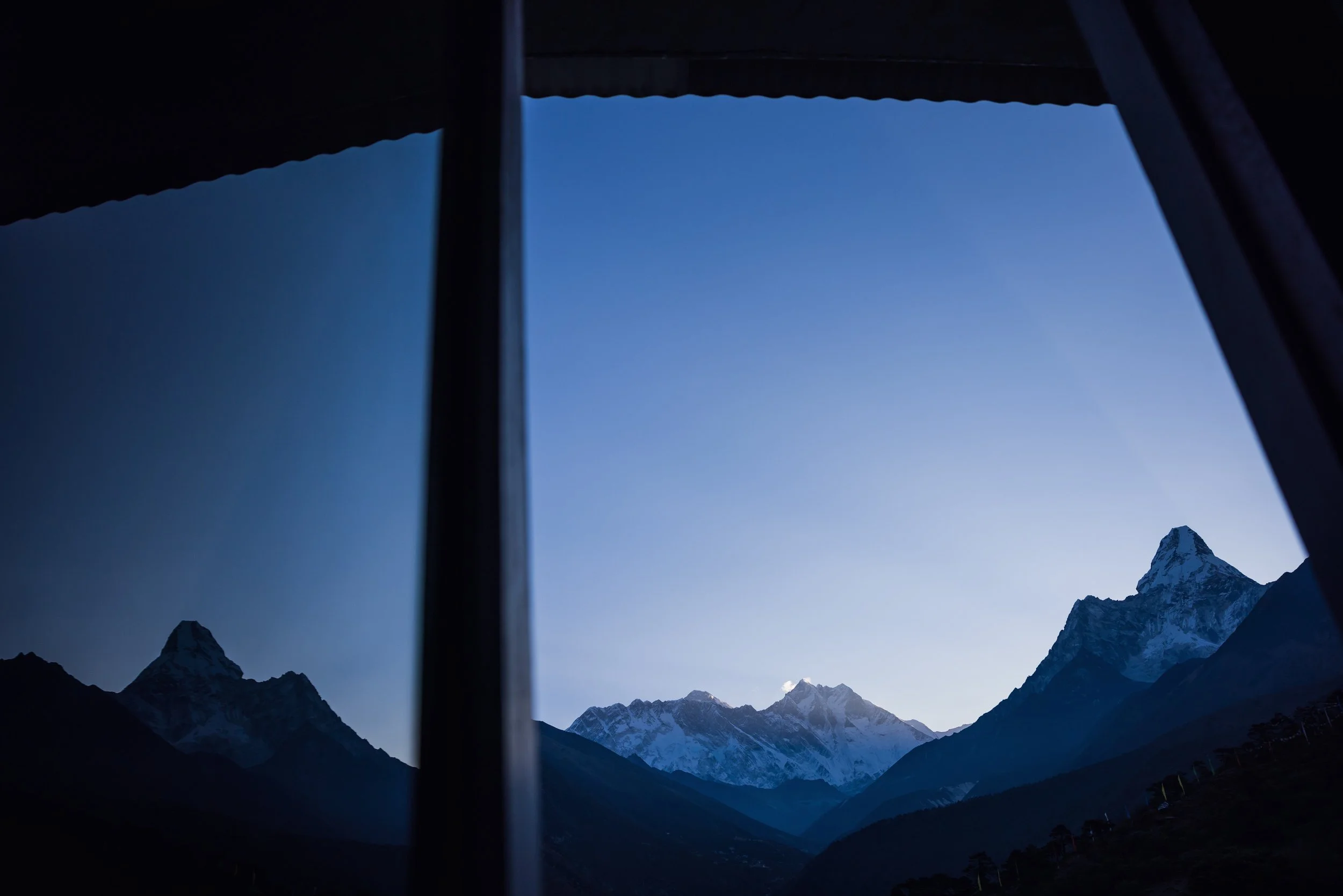
The summit of Everest peaks out from behind a ridge, center, while Ama Dablam looms as seen from a teahouse.

Prayer flags flutter on a ridge-line with Ama Dablam in the back.

Porters carry loads between Namche Bazaar and Khumjung.

A yak-cow hybrid called a dzo or zopkio ferries goods on a trail just below Everest Base Camp.

Everest Base Camp sprawls out on the flanks of the Khumbu glacier with the black summit pyramid of Everest visible at top right.

Apa Sherpa watches over his trekkers at the entrance to Everest Base Camp.
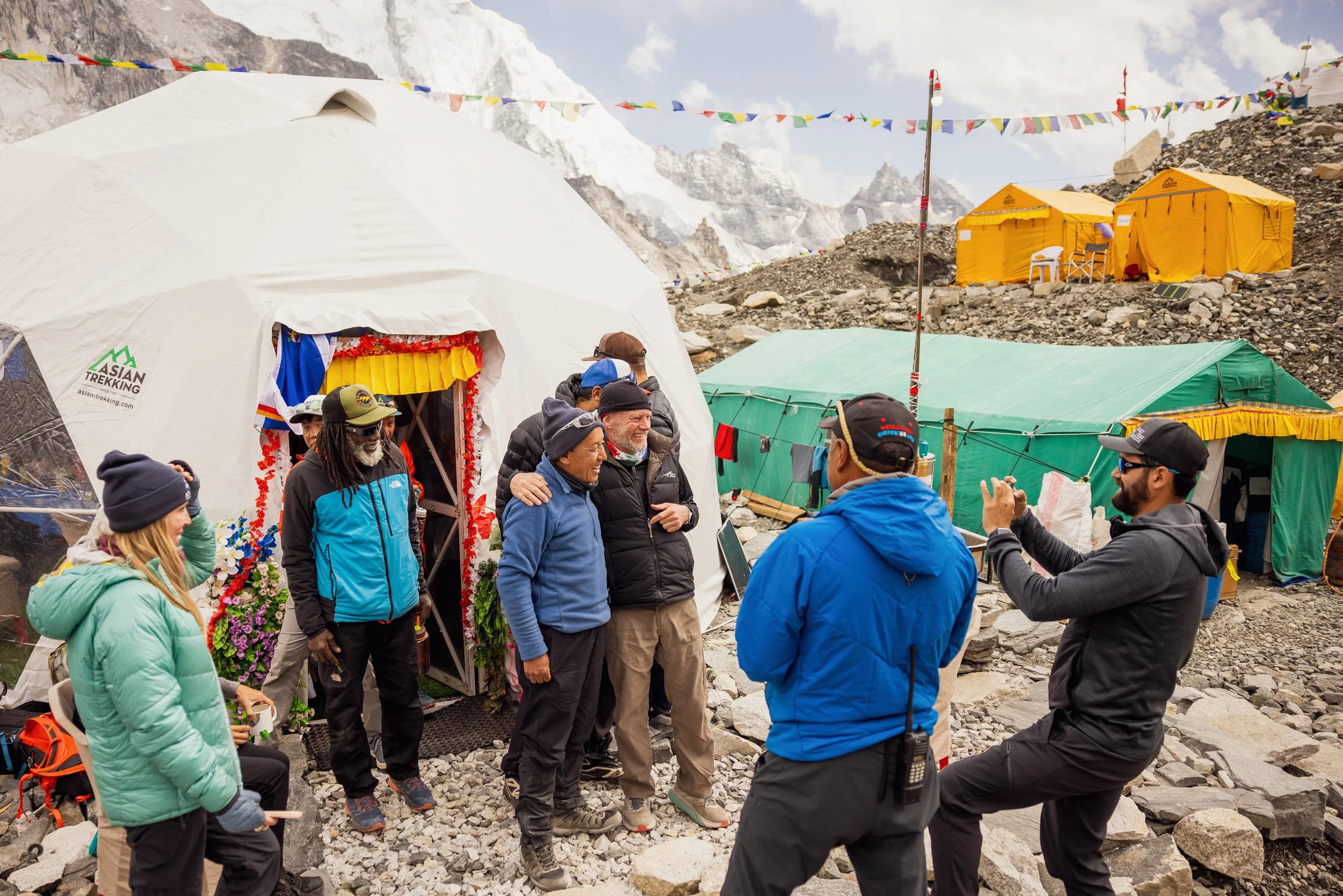
Apa Sherpa greets friends in Everest Base Camp.

Lights from Everest Base Camp, bottom left, cast a glow across the Khumbu Glacier as the lower flanks of Everest, center, and neighboring mountain Nuptse, right, are seen under a starry sky.